
The Village & its People
About the Mountains
History of Bulgaria
Bulgaria has been inhabited since antiquity, with evidence of some of Europe’s earliest civilizations, including the world’s oldest known gold treasure found near Varna. Thracian culture left rich tombs, treasures, and sanctuaries, later influenced by Greek colonization along the Black Sea. By the 1st century AD, the region became part of the Roman Empire, leaving cities and monuments such as those in Plovdiv.
After Rome’s fall, the area came under Byzantine control until the proto-Bulgarians and Slavs formed the First Bulgarian Empire in 681 under Khan Asparuh. Bulgaria grew powerful under rulers like Krum and Boris I, who introduced Christianity in 864. The creation of the Cyrillic alphabet by Cyril and Methodius’ followers and the reign of Tsar Simeon I marked a cultural “Golden Age.”
Conquered by Byzantium in 1018, Bulgaria regained independence in 1186, forming the Second Bulgarian Kingdom, which peaked under Ivan Asen II. In the late 14th century, the Ottomans conquered Bulgaria, ruling for centuries despite ongoing resistance and a national revival beginning in the 18th century.
Following the failed April Uprising (1876), Bulgaria was reestablished in 1878 after the Russo-Turkish War, though initially divided. It unified in 1885 and declared full independence in 1908. After losses in the Balkan Wars and World War I, Bulgaria aligned with Axis powers in World War II but later joined the Allies. Under communism after 1946, it remained under Soviet influence until democratic reforms began in 1989.
Since then, Bulgaria has transitioned to a democratic, market-based system, joining NATO in 2004 and the European Union in 2007.
The Western (Bulgarian) Rhodopi Mountains
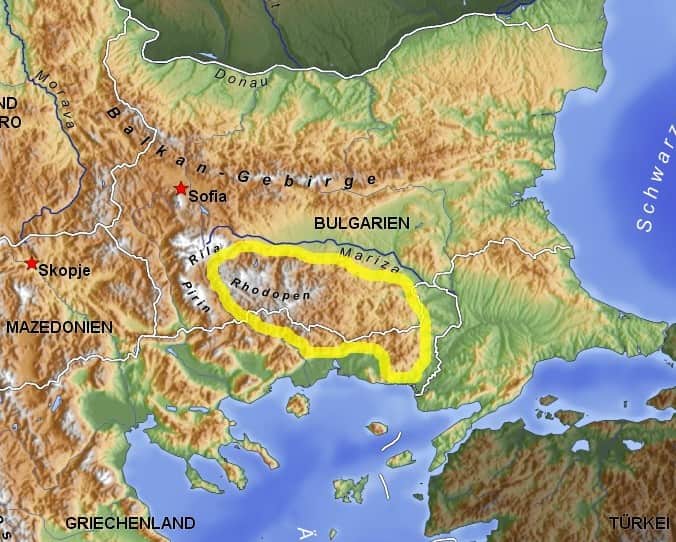
The Western Rhodopes are the largest (66% of the area of the Rhodopes in Bulgaria), The highest and best known peaks are located in the region (more than 10 are over 2,000 meters (6,562 ft) high) including the highest one, Golyam Perelik (2,191 meters (7,188 ft)). Another popular peak is Shirokolashki Snezhnik (2,188 meters (7,178 ft)),
Some of the deepest river gorges in the Rhodopes are located in the western parts, as well as the rock phenomenon Wonderful Bridges. Significant bodies of water include the Chaira lakes and the Dospat, Batak, Shiroka Polyana, Golyam Beglik and Tsigov Chark dams.
The town of Batak is also located in this part of the mountains, as well as the popular tourist centres Smolyan, Velingrad, Devin, Chepelare, the winter resort Pamporovo, the Eastern Orthodox Bachkovo Monastery, the ruins of the Asen dynasty's fortress, and the Devil's Throat, Yagodinska, and Uhlovitsa caves. The highest village in Bulgaria, Manastir (over 1,500 meters (4,921 ft)), is crouched in the northern foot of Prespa Peak. A number of architectural reserves, such as Shiroka Laka, Kovachevitsa, Momchilovtsi, Kosovo, are also located in the area.
Southern (Greek) Rhodopi Mountains
The Southern Rhodopes are the part of the mountain range that is located in Greece. The Rhodope regional unit in the northern part of the country is named after the region. This area includes the Rodopi Mountain Range National Park.[5]

The Southern Rhodopes are characterized by numerous peaks of relatively low altitude. Their highest peak is Delimposka (1,953m) in the mountain of Frakto, near the Greek-Bulgarian border. Nowadays the Southern Rhodopes is an area almost deserted. After World War II and the Greek Civil War most villages depopulated permanently and their inhabitants never returned. Even the Sarakatsani stockbreeders abandoned the difficult life of the Rhodopes. The depopulation of the region, that has not been grazed for more than 50 years, combined with high rainfall and its geographical location, has contributed to the creation and maintenance of a biological paradise. There grow coniferous trees, such as the Norway Spruce and the Silver Birch, that cannot be found elsewhere in Greece.
In the forest of Frakto there are 300-year-old trees, more than 50 metres high, and the endangered wild goat.
In the eastern part of the region there is the well known nature reserve of Dadia Forest, an ideal habitat for birds of prey, with 36 of the 38 species of birds of prey of Europe, like the rare Eastern imperial eagle and Lesser spotted eagle.