BGhols

The territory of Bulgaria has been inhabited since antiquity, as the country’s many ancient settlements and burial mounds attest. Present-day Bulgaria was a cradle of some of the earliest civilizations in Europe – the oldest gold ornament ever discovered, unearthed in the Chalcholite necropolis near Varna, is evidence of that. From the age of Ancient Thrace we have inherited valuable cultural monuments, including tombs (such as the Kazanlak tomb, the Aleksandrovska tomb, and the Sveshtarska tomb); treasures (the Panagyursko, Rogozensko, and Valchitransko teasures, among others); and sanctuaries and temples (at Perperikon, Starosel, Kozi Gramadi, Begliktash, and elsewhere).

The cultural interaction between the Thracians and the Hellenistic civilization were particularly dynamic. Many cities and towns heavily influenced by Greek culture were established between 6th-2nd century BC in Thrace, Misia and along the shores of the Black Sea. In the middle of the 1st century AD, all Bulgarian lands became a part of the Roman Empire. Many architectural and archaeological monuments have been preserved from this period, such as the Ancient Theater and the Roman Stadium in Plovdiv, and remains of the Roman cities Ulpia Escus, Nove, Nikopolis ad Istrum, Nikopolis ad Nestum, Augusta Trayana, and Abritus.

After the dissolution of the Roman Empire, the present Bulgarian lands came under the control of the East Roman Empire, later called Byzantium by historians. In the second half of the 7th century, the proto-Bulgarians settled in what is now Northeast Bulgaria. They united with the Slavs to form the Bulgarian state, recognized by Byzantium in 681. The head of the state was the leader of proto-Bulgarians Han Asparuh, and the city of Pliska was declared the state’s capital.

During the reign Han Krum (803-814), to the west Bulgaria bordered on the empire of Karl the Great, and to the east the Bulgarian armies reached the gates of the Byzantium capital, Constantinople. In 864, during the reign of Prince Boris I (852-889), Bulgarians adopted Christianity as its official religion, which makes Bulgaria one of the oldest Christian states in Europe.

At the end of the 9th century, the brothers Cyril and Methodius created and disseminated the Slavonic alphabet. Ohrid and Veliki Preslav became centers of the Bulgarian and Slavonic culture. From Bulgaria, the Slavonic alphabet spread to other Slavonic states as well. To the present day, Russia, Serbia, Ukraine, Macedonia and Belarus still use the Cyrillic alphabet, with rules of orthography established by the students of Cyril and Methodius and their followers in the Bulgarian capital Preslav. The reign of Tsar Simeon the First (893 – 927) is famous as the Golden Age of Bulgarian Culture, and the borders of the country at that time reached to the Black Sea, the Aegean Sea and the Adriatic Sea.

In 1018, after protracted warfare, Bulgaria was conquered by Byzantium. In 1186, the uprising led by the boyar brothers Asen and Peter, freed Bulgaria from Byzantine rule, establishing the Second Bulgarian Kingdom, with Tarnovo as its capital.

The former might of Bulgaria was restored during the rule of their youngest brother Kaloyan (who ruled from 1197-1207), and during the reign of Tsar Ivan Asen the Second (1218-1241), the Second Bulgarian Kingdom reached its zenith, achieving political hegemony in Southeast Europe. It expanded its borders to the Black Sea, the Aegean Sea and the Adriatic Sea, and greatly developed its economy and culture. Some of the most important monuments preserved from that time are the wall paintings in the Boyana church, the churches in Veliko Tarnovo, the Zemenski Monastery, the Ivanovski Rock Churches, the miniatures that illuminate the London Gospel, and the Manasiy Chronicle.

At the end of the 14th century, the country was conquered by the Ottoman Empire. In the first years of Ottoman rule there were scattered attempts to liberate the country. Later the Hayduk movement created the preconditions for an organized national liberation movement.

The Bulgarian Revival began at the beginning of the 18th century, when the Bulgarian church, educational institutions, and culture were re-established. The beginning of the organized national liberation movement to throw off the Ottoman yoke is marked by the activities of Georgi Rakovski (1821-1867), and key figures in the liberation movement are Vasil Levski (1837-1873), Lyuben Karavelov (1834-1879), Hristo Botev (1848-1876), among others.

In April 1876, the April Uprising took place. This was the largest and the best organized attempt to liberate Bulgaria from Ottoman domination. The uprising was brutally suppressed, but it placed the struggle for Bulgarian sovereignty at the center of international political discussions.

In 1878, with the Russian defeat of Turkey, the Bulgarian state was restored. The Berlin Congress (1878) divided the former Bulgarian territories into three parts – the Principality of Bulgaria, ruled by a prince, Eastern Rumelia, with a Christian governor appointed by the sultan, with Thrace and Macedonia remaining under Ottoman control. Alexander Battenberg was selected as the first prince of the Bulgarian Principality.

Bulgaria’s first constitution was adopted in 1879, and was one of the most democratic constitutions of its time. In 1885, the Principality of Bulgaria and Eastern Rumelia united. In 1908, the Bulgarian Prince Ferdinand Sachsen-Coburg-und-Gotha proclaimed Bulgaria’s independence from Turkey, and he was then declared Tsar of the Third Bulgarian Kingdom.

Bulgaria was victorious in the Balkan War of 1912, when together with Serbia and Greece the country gained the independence of Thrace and Macedonia. However, discord among the former allies led to the outbreak of the First Balkan War (1913), in which Bulgaria was defeated. As a result, territories predominantly inhabited by Bulgarians were cut off from the state. The participation of Bulgaria in the First World War on the side of the so called Allied Powers ended in national catastrophe. The Neuilly Peace Treaty (1919) imposed strict sanctions on Bulgaria, and the country lost much of its territory. In the Beginning of the 1940s, Bulgaria’s foreign policy reflected the interests of Germany and the Axis powers. In 1941, Bulgaria entered the war on the side of the Axis, but the Bulgarian army did not participate in the battles on the Eastern Front. During this time, Tsar Boris the Third, representing the general consensus, refused to deport some 50,000 Bulgarian Jews. Of all European countries, only Denmark and Bulgaria managed to save their Jewish populations from the Nazi gas chambers. In the autumn of 1944, Bulgaria joined the Allied Forces and actively participated in expelling the German forces from Southern and Central Europe.

After the Second World War, Bulgaria came under the political and economic influence of the USSR. In 1946 the country was declared a republic and the Bulgarian Communist Party came to power. All political parties except for the so-called Fatherland Front (Otechestven Front) were forbidden, the economy and the banks were nationalized, and the agricultural land was organized as collectives.

The democratic changes in Bulgaria started at the end of 1989, when multi-party elections were held and a new constitution was adopted. At this time Bulgaria began its transition to democratic development and a market economy. Its foreign policy was redirected towards rapprochement with European institutions. Since 1991, Bulgaria has been a member of the Council of Europe, and in 2004 Bulgaria became a member of NATO. In 1995, it filed an application to join the European Union, with negotiations commencing in 1999. On 25 April 2005, the Accession Treaty granting the Republic of Bulgaria the right to join the European Union was signed in Luxemburg. On 1 January 2007, after fulfilling all membership criteria, Bulgaria became of full-fl in Luxemburg was signed edged member of the European Union.

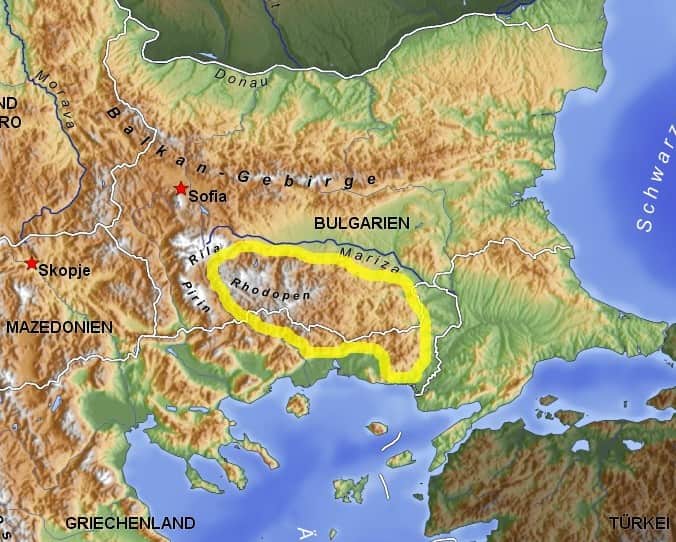
The Western Rhodopes are the largest (66% of the area of the Rhodopes in Bulgaria), higher, most infrastructurally developed, and most visited part of the mountains. The highest and best known peaks are located in the region (more than 10 are over 2,000 meters (6,562 ft) high) including the highest one, Golyam Perelik (2,191 meters (7,188 ft)). Among the other popular peaks are Shirokolashki Snezhnik (2,188 meters (7,178 ft)), Golyam Persenk (2,091 meters (6,860 ft)), Batashki Snezhnik (2,082 meters (6,831 ft)), Turla (1,800 meters (5,906 ft)).

Some of the deepest river gorges in the Rhodopes are located in the western parts, as well as the rock phenomenon Wonderful Bridges. Significant bodies of water include the Chaira lakes and the Dospat, Batak, Shiroka Polyana, Golyam Beglik and Tsigov Chark dams.

The town of Batak is also located in this part of the mountains, as well as the popular tourist centres Smolyan, Velingrad, Devin, Chepelare, the winter resort Pamporovo, the Eastern Orthodox Bachkovo Monastery, the ruins of the Asen dynasty's fortress, and the Devil's Throat, Yagodinska, and Uhlovitsa caves. The highest village in Bulgaria, Manastir (over 1,500 meters (4,921 ft)), is crouched in the northern foot of Prespa Peak. A number of architectural reserves, such as Shiroka Laka, Kovachevitsa, Momchilovtsi, Kosovo, are also located in the area.

The Southern Rhodopes are the part of the mountain range that is located in Greece. The Rhodope regional unit in the northern part of the country is named after the region. This area includes the Rodopi Mountain Range National Park.[5]

Eastern imperial eagle

The Southern Rhodopes are characterized by numerous peaks of relatively low altitude. Their highest peak is Delimposka (1,953m) in the mountain of Frakto, near the Greek-Bulgarian border. Nowadays the Southern Rhodopes is an area almost deserted. After World War II and the Greek Civil War most villages depopulated permanently and their inhabitants never returned. Even the Sarakatsani stockbreeders abandoned the difficult life of the Rhodopes. The depopulation of the region, that has not been grazed for more than 50 years, combined with high rainfall and its geographical location, has contributed to the creation and maintenance of a biological paradise. There grow coniferous trees, such as the Norway Spruce and the Silver Birch, that cannot be found elsewhere in Greece.

In the forest of Frakto there are 300-year-old trees, more than 50 metres high, and the endangered wild goat.

In the eastern part of the region there is the well known nature reserve of Dadia Forest, an ideal habitat for birds of prey, with 36 of the 38 species of birds of prey of Europe, like the rare Eastern imperial eagle and Lesser spotted eagle.

©2026 BGhols Всички права запазени - Задвижвано отLodgify